Header image
Department of Physics
Wabash College
line decor
HOME  :: research ::  
line decor
 
news

12 August 2010

I worked with Chris Gorman this summer on optimizing the halo trap design. It was a productive summer and we submitted a paper for publication. We also trapped polystyrene nanospheres in a linear Paul trap.


26 June 2009

dust_halo

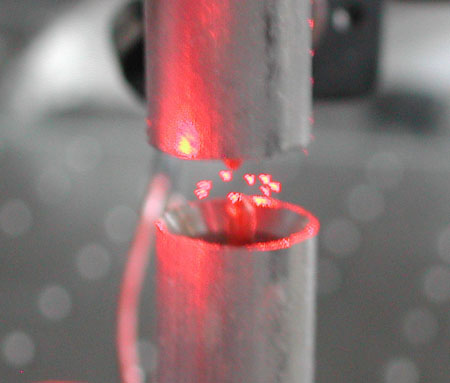
We are also working on a new type of compact halo ion traps. We built a simple model of this type of trap using 14 gauge copper wire and aluminum rod stock as the electrodes. The picture above shows about 10 glass microspheres trapped in the halo trap. The spheres are classically scattering red laser light to make them visible. The trap is a 60 Hz, 400 VAC Paul trap.

22 June 2009

Yb Beam

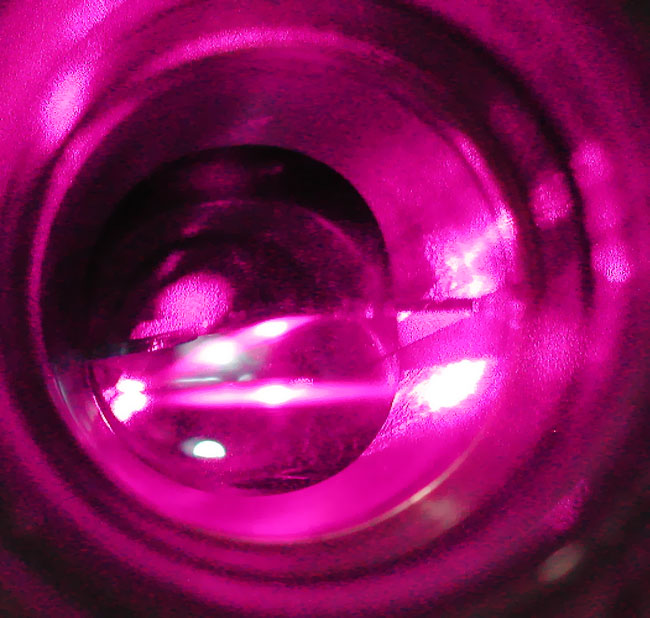
We worked long and hard to try and get the calcium ion trap working. Things did not seem to go our way and we had trouble getting the experiment to work. So we took one step sideways and re-tuned our 397nm laser up a bit to the S1 to P1 transition in neutral ytterbium. We made a simple setup with the ytterbium oven shooting straight up and hitting a glass slide. The slide showed us spots were the ytterbium was depositing, so we figured the oven was working well. We directed the laser through the vacuum chamber and the picture above shows what we saw: atmoic flourescence on the neutral ytterbium line! The wavemeter and the laser were right on. The bright spot just below the slide is the atomic beam intersecting with the laser. The light scattering on either side of the spot comes from ytterbium vapor hitting the glass slide and then bouncing around the chamber. We are interested in pursuing this line of research to see what we can do with the ytterbium beam.

25 August 2008

trap

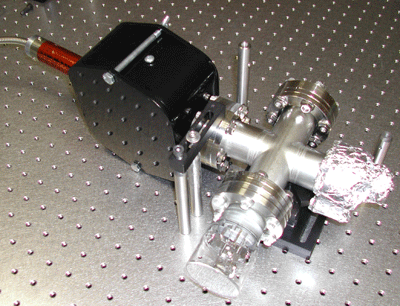
A lot has happened in the last year. We have borrowed a vacuum system from Chris Monroe and have built our own ion trap chamber to attach to the system. A picture of our vacuum chamber is below.

You can see the 5-rod trap in the middle, the calcium oven at the bottom and the two electron guns behind the trap jig. The vacuum chamber bake-out went very well and the entire chamber now sits at about 2x10^-11 torr.

We have adjusted the wavelength we use for trapping. We had been trying with two lasers at 396.847 nm and 866.214nm, both read as "vacuum" wavelengths on our Coherent wavemeter. We have corrected the wavelengths and now use the following data:

Laser Wavenumber Wavelength (in vacuum) Wavelength (in air) Frequency
396 25191.536 cm^-1 396.958 nm 396.848 nm 755223.2 GHz
866 11541.316 cm^-1 866.452 nm 866.214 nm 345999.9 GHz

We have both beams overlap before going through a single 15 cm lens which focuses them both on the trap.

Light from the trap is collected using a Special Optics lens (Part no: 54-17-30-397nm) and then is sent through a 200 micron pinhole, a doublet (2 x 10cm plano-convex lenses) and then to a PMT (Hamamatsu R928) set at 1200 V. The photon counts are cleaned up with a pulse discriminator and then counted on a DAQ board.


15 June 2007

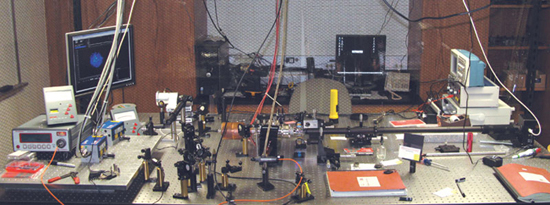
The lasers are on the table and we are working on trapping calcium ions. We have set up the wavemeter for continuous measurment of the wavelength. We are currently running the camera, the wavemeter, and a vacuum pressure monitor using a LabView controller on a new dual-monitor computer. So far, we have not seen any calcium in the trap, but we will keep working on this in the Fall.
summer 2007
lasers

29 Sep 2006

The Toptica lasers, the Coherent Wavemeter, and the trap are now unpacked and on the table. There is a lot of work left to be done before everything is ready to try trapping, but this is a good start.

blank table

29 Sep 2006

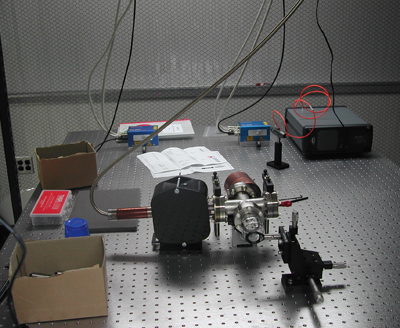
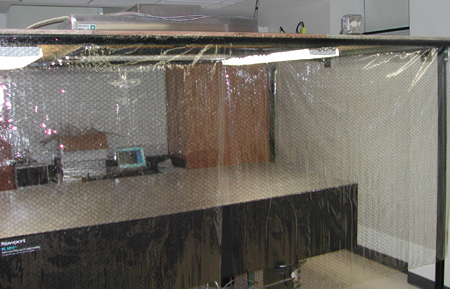
The laser table is finally ready to go. The HEPA filter is running, the curtains are up and the table is floating.

chamber

1 July 2006

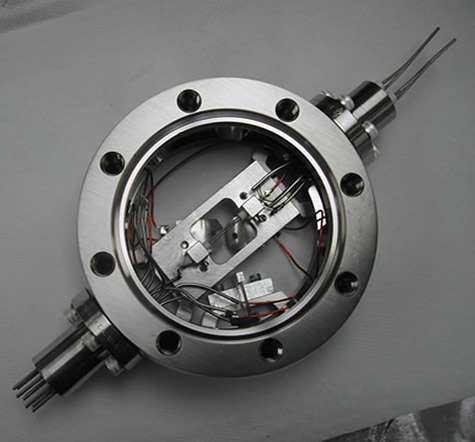
The vacuum chamber and trap successfully made it to Wabash from their production in Ann Arbor, MI.